Reading 3 of 6 free1776 Club · all 6 storiesWednesday, November 4
From the desk
Start with 1924, when Wyoming voters elected a woman who never campaigned. Nellie Tayloe Ross had told a party committee she would not accept the nomination after her husband, the governor, died in October, and she still beat E. J. Sullivan, 43,323 to 35,275. Worth a longer look is 1979, when 300 to 500 students overran the U.S. embassy in Tehran and blindfolded the Marines inside. For a quieter turn, 1939 ended the arms embargo and let Britain and France buy weapons for cash.
— The Patriot Compass desk
1924Featured · This day in history
Wyoming elects Nellie Tayloe Ross governor; the widow who said no never campaigned
Wyoming's Democratic governor, William B. Ross, had died in office on October 2, 1924, and the state needed someone to finish his term. On November 4, voters in a special election chose his widow, Nellie Tayloe Ross, over Republican nominee E. J. Sullivan, 43,323 votes to 35,275. She had told a party committee she would not accept the nomination, and she never campaigned. Ross became the first woman elected governor in the United States, and she took office on January 5, 1925.
Ross's election made a woman governor by popular vote for the first time. In Cheyenne she backed Prohibition and urged Wyoming to ratify the pending federal child labor amendment, tying a state house to two of the era's national fights. Her loss in 1926 showed how brief the opening could be.
Did you know
QWhy did E. J. Sullivan need several rounds of balloting to win the Republican nomination when Ross's nomination took only one vote?
The Republican emergency convention on October 14, 1924, could not settle on a nominee at once. Delegates went through several rounds of balloting before E. J. Sullivan emerged as the party's candidate. The Democrats in Cheyenne met the same day, but adjourned for several hours when Charles D. Carey hesitated to accept the nomination. The other Democratic candidates withdrew, and Nellie Tayloe Ross was nominated unanimously. The two conventions started from the same vacancy and the same short deadline. One came out of the day with a divided process and the other with a single name. Sullivan then faced a Democratic nominee who had no rival inside her own party.
QWhat did Wyoming's attorney general rule on October 9, 1924, about how candidates could get on the ballot?
The opinion, issued October 9, answered a request Frank Lucas had made on October 6. It said candidates could reach the ballot in either of two ways: by petition, as independents, or by nomination at party conventions. That ruling opened the door to the emergency conventions both parties had scheduled for October 14, only five days later. From William B. Ross's death on October 2 to the November 4 vote was 33 days. Within that span, the state had to get a legal opinion, hold two conventions, and send nominees to the voters.
QHow close to the filing deadline did Nellie Tayloe Ross actually commit to running?
Ross's yes came late. After she told the Democratic committee she would not accept, she committed just before the filing deadline. The window between her refusal and her commitment was short enough that the party's other candidates had already withdrawn by the time she agreed. Her own account does not describe a campaign of persuasion by argument. She said she was overwhelmed by the loyalty of the friends around her and was committed before she had fully decided. The deadline left the Democrats little room to find another nominee if she had held to her first answer.
The Daily Record · free by email
Tomorrow's edition in your inbox — one story, one quote, the flag.
1962military
Tightrope flies from Johnston Island, and Operation Fishbowl is finished
More than three months after a Bluegill Prime missile blew up on its Johnston Island pad, the United States finished what it had started in the Pacific. On November 4, 1962, a low-yield device named Tightrope rose on an XM-33 Strypi rocket, the final shot of Operation Fishbowl. It was also the last atmospheric nuclear test the United States conducted. The 1963 Partial Nuclear Test Ban Treaty then left the United States only underground tests.
Tightrope closed the era of American nuclear tests in the open sky. The 1963 Partial Nuclear Test Ban Treaty barred tests in the atmosphere, underwater and in space. American testing went underground. What Fishbowl taught about electromagnetic pulse and radiation belts informed military planning and satellite protection.
Did you know
QWhich satellites did Starfish Prime cripple, and how long did the last one hold out?
The artificial radiation belts created by Starfish Prime on July 9, 1962, damaged or failed several satellites: Traac, Transit 4B, Injun I, Telstar I and Ariel. The Soviet satellite Kosmos 5 was on the list too. Telstar I lasted longest. It did not fail completely until February 21, 1963, a little over three months after Tightrope flew from Johnston Island. The radiation made no distinction between American, British and Soviet hardware, and the damage to the new communications satellite showed anyone launching spacecraft that events above the Pacific mattered to them.
QHow far from the blast did Starfish Prime start shutting off the lights?
About 1,445 kilometers, or 900 miles. That was the distance from the Starfish Prime detonation to Hawaii, where the electromagnetic pulse damaged electrical systems. Streetlights went out, burglar alarms went off, and a telephone company microwave link was damaged. Electromagnetic pulse was one of the very questions Fishbowl had been designed to answer, and the planners had listed it alongside auroras, radiation belts and radio blackouts. Hawaii supplied a demonstration at a range few had expected. The shot took place about two weeks before the Bluegill Prime accident.
QWhy did auroras appear over Samoa, Fiji and Tonga after tests fired near Johnston Island?
Charged particles from the bursts followed the Earth's magnetic field. A Defense Department reference explains that for the tests near Johnston Island, particles entered the atmosphere in the northern hemisphere between Johnston Island and the main Hawaiian Islands, while the matching point at the other end of the magnetic field lines lay near the Samoan, Fiji and Tonga Islands. Auroras were observed in those areas as well as near the explosions. During Checkmate, observers at Samoa saw a white flash that faded to orange and vanished in about a minute. The sky 2,000 miles from the launch site was part of the experiment.
1979government
Students storm the U.S. embassy in Tehran and seize hostages; they want the Shah sent home
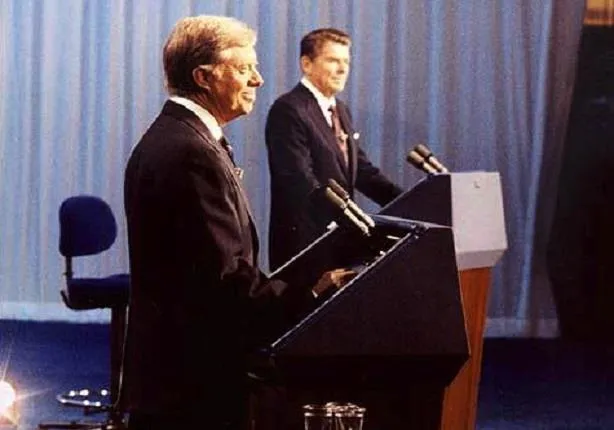
On November 4, 1979, between 300 and 500 Iranian students overran the U.S. embassy in Tehran, angry that the Carter administration had granted asylum to the exiled Shah for cancer treatment. They blindfolded the Marines and embassy staff and paraded them in front of photographers. The students took approximately 90 hostages, 66 of them Americans at first, and demanded that the United States hand over Mohammad Reza Pahlavi. Ayatollah Khomeini, leader of the revolution that had deposed the Shah, backed them.
The seizure began a standoff that dominated the final year of Jimmy Carter's presidency and fed into his landslide loss in the 1980 election. The remaining hostages were released minutes after Ronald Reagan's inauguration. Sanctions on Iran, still a fixture of American foreign policy, trace back to this crisis.
Did you know
QWhy were a woman and two African American hostages freed about two weeks after the takeover, and what did they have to do first?
On November 19, 1979, fifteen days after the takeover, the hostage-takers released one woman and two African Americans. The students used their captives to make a public point. Before the three were let go, they were required to praise the aims of the revolution at a press conference. The release was framed as proof of the revolution's character, and the condition attached to it turned their freedom into a public statement. The rest of the hostages remained inside the embassy. Later releases were rare, and Richard Queen, freed on July 11, 1980 because of illness, was among the few.
QHow did six Americans who slipped away from the embassy finally get out of Iran?
Six American diplomats evaded capture when the embassy fell, so they were never counted among the hostages. Their escape came on January 27, 1980, in an operation known as the Canadian Caper, less than three months after the takeover. The six left Iran using Canadian passports and a cover story that identified them as a film crew. The ruse worked on paperwork and a cover story. The episode stands apart from the rest of the crisis, which otherwise offered Washington few victories. The 52 Americans still held in Tehran stayed there for another year.
QWhat happened to the military rescue attempt, and who resigned over it?
Operation Eagle Claw, the American military attempt to free the hostages, took place on April 24, 1980, about five and a half months after the embassy was seized. It failed. The operation ended with the deaths of eight American soldiers and one Iranian civilian, and no hostages were reached. Secretary of State Cyrus Vance resigned after the failed operation. For the Carter administration, the failure closed off the most direct option it had tried, and the crisis continued through the rest of the election year, ending only after the Algiers Accords, the agreement that released the hostages, were signed.
$17.76 your first year · then $39.99/yr · cancel anytime
Quote of the day
“We have all known the long loneliness and we have learned that the only solution is love and that love comes with community.”
Dorothy Day
“Whether our ancestors came here on the Mayflower, on slave ships, whether they came to Ellis Island or LAX in Los Angeles, whether they came yesterday or walked this land a thousand years ago our great challenge for the 21st century is to find a way to be One America. We can meet all the other challenges if we can go forward as One America.”
Bill Clinton
“The establishment of our new government seemed to be the last great experiment for promoting human happiness by a reasonable compact in civil society”