Reading 3 of 6 free1776 Club · all 6 storiesMonday, October 26
From the desk
Start with 1774: twelve colonies, seven weeks of argument inside Carpenters' Hall, and a plan stopping short of independence, a boycott starting December 1 and a promise to meet again if London stayed silent. Georgia sat it out, so the compact held on eleven others plus itself. Worth a longer look: Ida B. Wells, who in 1892 answered the mob that drove her from Memphis with a pamphlet, Southern Horrors, built case by case from evidence. Leyte Gulf ended the same day in 1944, the last time Japan's navy sailed in real force.
— The Patriot Compass desk
1774Featured · This day in history
The Congress breaks up; the colonies now have a boycott and a date to reconvene
For seven weeks, delegates from twelve colonies had argued inside Carpenters' Hall over how far to push back against Parliament's Intolerable Acts. On October 26, 1774, the First Continental Congress adjourned, having settled on a plan that went beyond simple petition without declaring independence: a boycott of British goods starting December 1, and a pledge to reconvene the following spring if London did not answer. Georgia's absence left the compact resting on twelve colonies, not thirteen. The delegates went home to sell the agreement to their own legislatures and committees.
The Congress's closing act, a mutual boycott binding colonies that had no legal authority over each other, functioned like an early version of federalism: separate governments agreeing to act as one. The vote to reconvene if grievances went unanswered turned a one-time protest meeting into a standing institution, the body that declared independence twenty-one months later.
Did you know
QWhy did Georgia skip the First Continental Congress entirely?
Georgia was the only one of the thirteen colonies to send no delegates to Philadelphia in 1774. Loyalist sentiment ran stronger there than Patriot sentiment at the time. The colony depended on British troops and subsidies for protection against Creek and Cherokee nations on its frontier, and its royal governor kept tighter control over the assembly than counterparts elsewhere. Georgia stayed out of the revolutionary coalition for roughly another year before shifting course and joining the cause in 1775.
QHow were the fifty-six delegates actually chosen to sit in Carpenters' Hall?
There was no single method. Some delegates were picked directly by colonial legislatures, others by popular election, and still others by a colony's Committee of Correspondence acting on its own authority, since many assemblies had already been dissolved by royal governors for defying Parliament. That patchwork meant the men gathered at Carpenters' Hall carried different degrees of formal mandate from home, yet the Congress treated every delegation as equal regardless of how it got there. The rules of debate were written specifically to protect that equality, giving a small colony's delegation the same standing as Virginia's or Massachusetts's.
QHow did Congress open its very first working session back in September?
On September 6, delegate Thomas Cushing proposed that each day's business begin with prayer, an idea Samuel Adams backed by nominating Anglican clergyman Reverend Jacob Duché to lead it. Duché opened by reading the 35th Psalm, a passage considered strikingly appropriate to the delegates' uncertain circumstances, then followed it with an extended prayer that was, by contemporary accounts, warmly received by men still uncertain whether they were rebels or petitioners.
The Daily Record · free by email
Tomorrow's edition in your inbox — one story, one quote, the flag.
1944military
Four days of battle end: Japan's navy leaves Leyte Gulf broken
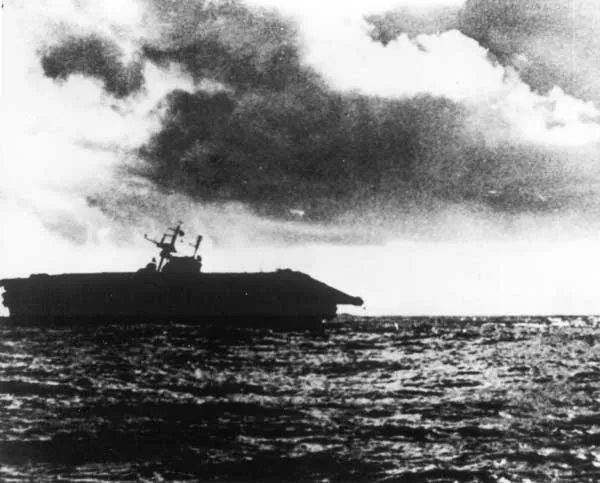
For four days the waters around the Philippines held the largest naval battle ever fought. On October 26, 1944, the fighting at Leyte Gulf finally stopped, and Admiral Soemu Toyoda's Combined Fleet limped away having lost much of what remained of its carrier and battleship strength. More than 200,000 naval personnel had taken part across four main engagements and several lesser actions. Japan's navy never again sailed in comparable force for the rest of the war.
Leyte Gulf secured the Philippine campaign General Douglas MacArthur had promised two years earlier, and it ended Japan's ability to contest the sea around the islands. The battle also introduced America's military to organized kamikaze attacks, a tactic the Navy had to account for in the amphibious assaults that followed.
Did you know
QWhat happened to Vice Admiral Kurita when his flagship went down before the battle even reached its climax?
Kurita had to swim for his life. On October 23, before his Center Force had even engaged the American surface fleet, the submarines Darter and Dace caught his ships in the Palawan Passage and sank his flagship, the heavy cruiser Atago. Kurita was pulled from the water and transferred to the battleship Yamato to continue commanding the force. He went on to lead that same Center Force through San Bernardino Strait two days later, arriving off Samar still in command despite having lost his ship, his staff's equipment, and nearly his life before a single large-caliber shell had been fired at him by a surface ship.
QWhy did the light carrier USS Princeton become more dangerous to American ships than to the enemy that hit her?
A single bomb hit during the Sibuyan Sea fighting turned the Princeton into a floating hazard for her own fleet. The strike set off stored torpedoes and bombers on board, and the resulting explosions tore into the nearby cruiser USS Birmingham, which had pulled alongside to help fight the fires. The secondary blasts caused heavier casualties on Birmingham's deck than the original bomb had caused aboard Princeton itself. The carrier eventually had to be scuttled by her own task force rather than saved, proof that a single hit on a ship loaded with ordnance could wound two vessels at once.
QWhat fuel problem had Japanese strategists already warned about before the battle began?
Japanese naval planners had flagged the danger in their own strategic assessments: losing the Philippines would sever the shipping lanes connecting the home islands to the oil fields their fleet depended on. One internal assessment warned that even if ships survived the fighting, a fleet pushed back to Japanese waters afterward could not obtain its fuel supply. The fuel shortage happened just as predicted. Surviving warships sat idle in port for the rest of the war not because they lacked crews or ammunition, but because there was no fuel left to send them anywhere, a strategic bottleneck Japanese commanders had identified as a risk before the first shot at Leyte was fired.
1958general
Pan Am's jet lands at Le Bourget; New York to Paris in six hours of air time
For three decades, crossing the Atlantic by air meant nine droning hours behind piston engines. On October 26, 1958, Pan American World Airways flew a Boeing 707 named Clipper America out of New York's Idlewild Airport, carrying 111 passengers and 12 crew toward Paris. The jet paused to refuel at Gander, Newfoundland, then pressed on to Le Bourget Airport, cutting the flying time to roughly six hours. Propeller travel across the Atlantic was finished.
Pan Am's flight put an American-built jet, flown by an American carrier, at the front of the Jet Age, forcing airports and air traffic control nationwide to modernize around jet speed, with airline catering close behind. The Boeing 707 made American manufacturing synonymous with commercial aviation for a generation.
$17.76 your first year · then $39.99/yr · cancel anytime
Quote of the day
“Nobody will ever deprive the American people of the right to vote except the American people themselves.”
Franklin D. Roosevelt
“The fate of the country does not depend on how you vote at the polls — the worst man is as strong as the best at that game; it does not depend on what kind of paper you drop into the ballot-box once a year, but on what kind of man you drop from your chamber into the street every morning.”
Henry David Thoreau
“Let me now take a more comprehensive view, and warn you in the most solemn manner against the baneful effects of the spirit of party, generally.”