Reading 3 of 6 free1776 Club · all 6 storiesSunday, October 25
From the desk
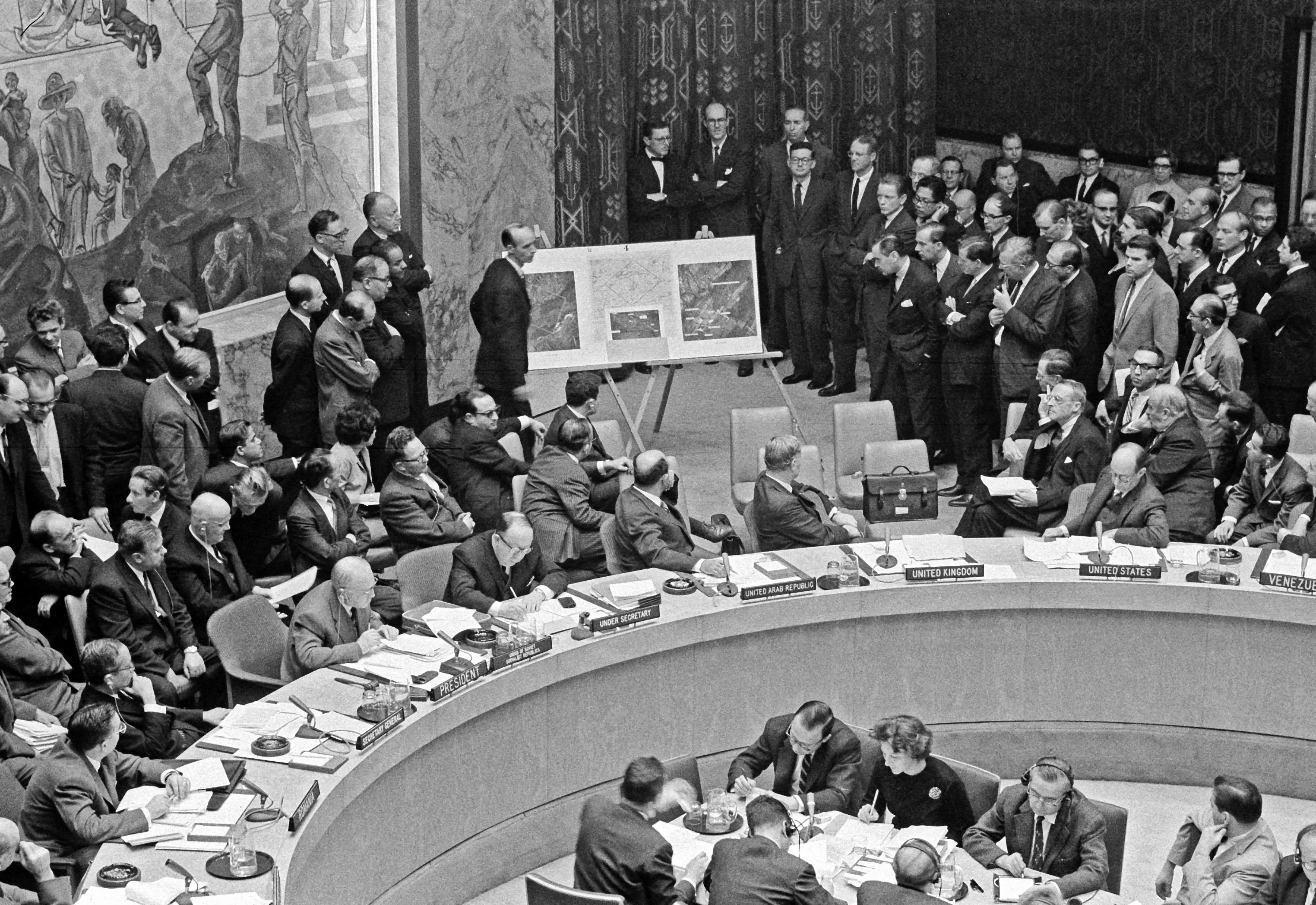
Start with 1812: Stephen Decatur's USS United States catching HMS Macedonian at dawn, 500 miles south of the Azores, then holding range so his 24-pounders could outreach her 18s. By noon Macedonian was a dismasted hulk with 104 dead or wounded; the Americans lost twelve. Worth a longer look is 1962, when Adlai Stevenson laid reconnaissance photographs on the table at the U.N. and dared Zorin to deny what was in them. The 1944 loss of USS Tang, sunk by her own last torpedo, is worth a minute too. A crowded date: war at sea, war by photograph.
— The Patriot Compass desk
1812Featured · This day in history
USS United States Captures HMS Macedonian in Mid-Atlantic Duel
Four months into the War of 1812, American frigates had yet to prove themselves against the Royal Navy on the open ocean. On October 25, 1812, Captain Stephen Decatur's USS United States spotted HMS Macedonian at dawn, 500 miles south of the Azores, and opened fire around 0920. Decatur held his range to let his 24-pounders outreach Macedonian's 18-pounders, and a broadside that wrecked her mizzen top mast settled the maneuvering advantage. By noon the British frigate was a dismasted hulk with 104 casualties; United States had lost 12 men and had suffered little damage.
The United States was one of six frigates Congress authorized in 1794 to build a navy from nothing, and Macedonian was the first British warship brought into an American harbor as a prize of war. Congress and President Madison publicly praised Decatur's crew, and the prize itself was bought into US service under its own name. It turned a four-month-old war into proof that the young republic's frigates could beat the Royal Navy ship to ship.
Did you know
QWhat was Samuel Leech doing aboard Macedonian during the battle, and why does his account matter?
Samuel Leech was a 13-year-old crew member serving aboard HMS Macedonian during the engagement, young enough that his later memoir gave historians a rare firsthand sailor's view of the fight rather than an officer's report. Most surviving accounts of the battle come from captains and logbooks, but Leech wrote down what the lower deck experienced as American 24-pound shot tore into the ship. His memoir became one of the few ground-level descriptions of a War of 1812 naval engagement from the British side. A teenager's diary, in effect, outlasted the admirals' dispatches.
QHow did the two frigates actually compare in size and firepower before a shot was fired?
USS United States weighed in at 1,576 tons burthen and carried thirty-two 24-pounder cannon, giving her a broadside of 864 pounds of shot. HMS Macedonian, by contrast, displaced 1,082 tons and mounted twenty-eight 18-pounders, throwing only 528 pounds per broadside. That gap meant Decatur's ship could hurl roughly 60 percent more metal with each volley, a mismatch Carden's wager never accounted for. Over the course of the engagement United States fired seventy broadsides to Macedonian's thirty, a rate British gun crews simply could not match once their rigging was crippled. The numbers alone suggest the outcome was decided as much in the shipyards as on the water.
QWhat mission was Macedonian on before she ever crossed paths with Decatur's ship?
In September 1812 HMS Macedonian had been ordered to escort an East Indiaman as far as Madeira, a routine convoy duty protecting merchant shipping on the Atlantic trade route. She left Madeira on October 22, only three days before the battle, with orders to cruise independently for prizes of her own. Carden was hunting American merchant vessels when he instead found an American warship. The convoy assignment that preceded the battle had nothing to do with the United States squadron at all, the two frigates met almost by accident rather than by design.
The Daily Record · free by email
Tomorrow's edition in your inbox — one story, one quote, the flag.
1940military
Davis becomes the Army's first Black general
By the fall of 1940, Benjamin O. Davis Sr. had spent over four decades in uniform and ten years since his promotion to colonel in 1930, yet the War Department's promotion list for that year did not include his name. On October 25, 1940, President Franklin D. Roosevelt reversed that decision and named Davis a brigadier general, making him the first African American general officer in United States military history. Roosevelt's staff called the earlier omission an oversight. Davis took command of the 4th Cavalry Brigade at Fort Riley, Kansas, that January.
Roosevelt's reversal came weeks before a presidential election he needed Black voters to help him win a third term, tying a military first directly to domestic politics. Davis's star opened the door the Army had kept shut for over a century. His wartime inspections of segregated Black units later became part of the record cited when Truman desegregated the armed forces.
Did you know
QWhat overseas posting did Davis hold before his Army career reached the general's star?
Davis served as a military attache in Liberia, a diplomatic assignment unusual for any Army officer of his era and especially so for a Black officer confined by the Army's segregated personnel system. He also served as a professor of military science and later commanded the 369th Infantry Regiment, a Black unit with its own distinguished combat lineage. These postings formed part of the record the Army itself described as superior technical and tactical proficiency, built up over decades in roles far removed from combat command. Segregation routinely barred Black officers from leading troops in the field. That record became the resume Roosevelt's staff pointed to once they needed a justification for reversing the 1940 omission.
QWhat age threshold almost ended Davis's career before his star ever arrived?
The Army's mandatory retirement age stood at 64, and Davis was 63 when the 1940 promotion list came out without his name. Army leaders cited his proximity to that cutoff as the stated reason for leaving him off, treating one year of eligibility as disqualifying while white colonels of similar age moved ahead. That same age threshold mattered again less than a year later: Davis reached mandatory retirement on July 31, 1941, formally leaving active duty on schedule, only to be recalled the following day. The same age threshold that nearly blocked his promotion resurfaced when he was recalled a year later to inspect segregated units.
QWhat kind of election was Roosevelt fighting when he reversed course on Davis?
Roosevelt was campaigning for an unprecedented third term in the White House, something no previous president had sought, and the race was close enough that Black voters represented a bloc he could not afford to lose to rival candidates. That campaign pressure, arriving in late October with the election just weeks away, is what pushed Roosevelt's staff to revisit a promotion list the War Department had already closed. The reversal landed within days of the vote, eight days before Roosevelt's bid for a third term.
1944military
Tang's own torpedo circles back and sinks her; nine men swim through the night
Just after midnight on October 25, 1944, USS Tang was finishing the most devastating patrol of any American submarine in the war when her final torpedo, a Mark 18, curved back on itself and struck her own aft torpedo room. The submarine sank by the stern into 180 feet of water in the Formosa Strait. Of 87 men aboard, nine escaped and survived, including Commander Richard O'Kane, who swam through the night until a Japanese frigate pulled him from the water eight hours later.
Tang sank 33 ships, more than any other American submarine, and her loss became part of the Navy's postwar reviews of torpedo design. The Mark 18's circular-run flaw, already suspected after other incidents, pushed the service toward new safety interlocks and testing standards for torpedoes in the years that followed.
Did you know
QHow old was the youngest sailor lost when Tang went down?
Rubin MacNiel Raiford was just 15 years old when he died in the sinking, making him one of the youngest Americans killed aboard a submarine in World War II. Recruiting standards of the era were not always strictly enforced, and teenagers occasionally slipped into service on forged paperwork or inflated ages. Raiford was among the 78 men who never made it out of Tang's flooding compartments. Raiford's age was unusual even for a crew that had just completed the most successful submarine patrol record of the war.
QWhat happened to the one man who got close to rescue but never made it?
A sailor who surfaced near the group of five men rescued from the Momsen lung escape was injured during the ascent and was never pulled from the water. He had made it out of the sunken hull and through 180 feet of open water, only to die within sight of the men who survived. No further detail survives on the nature of his injury or how long he lasted after reaching the surface. His death left only five of the original thirteen men who escaped the forward torpedo room alive.
QHow did a survivor turn his own trousers into a life preserver?
One officer who escaped the flooded conning tower had no flotation gear, so he knotted the legs of his pants, filled them with trapped air, and used the improvised bladder to stay afloat in the dark water of the Formosa Strait. The trick kept him alive long enough to be swept into the same group of survivors treading water through the night. No training manual covered the trick, but it kept him afloat until he was among the nine men hauled from the sea the next morning by the Japanese frigate CD-34.
$17.76 your first year · then $39.99/yr · cancel anytime
Quote of the day
“Nobody will ever deprive the American people of the right to vote except the American people themselves.”
Franklin D. Roosevelt
“The fate of the country does not depend on how you vote at the polls — the worst man is as strong as the best at that game; it does not depend on what kind of paper you drop into the ballot-box once a year, but on what kind of man you drop from your chamber into the street every morning.”
Henry David Thoreau
“Let me now take a more comprehensive view, and warn you in the most solemn manner against the baneful effects of the spirit of party, generally.”