Reading 3 of 6 free1776 Club · all 6 storiesSaturday, October 17
From the desk
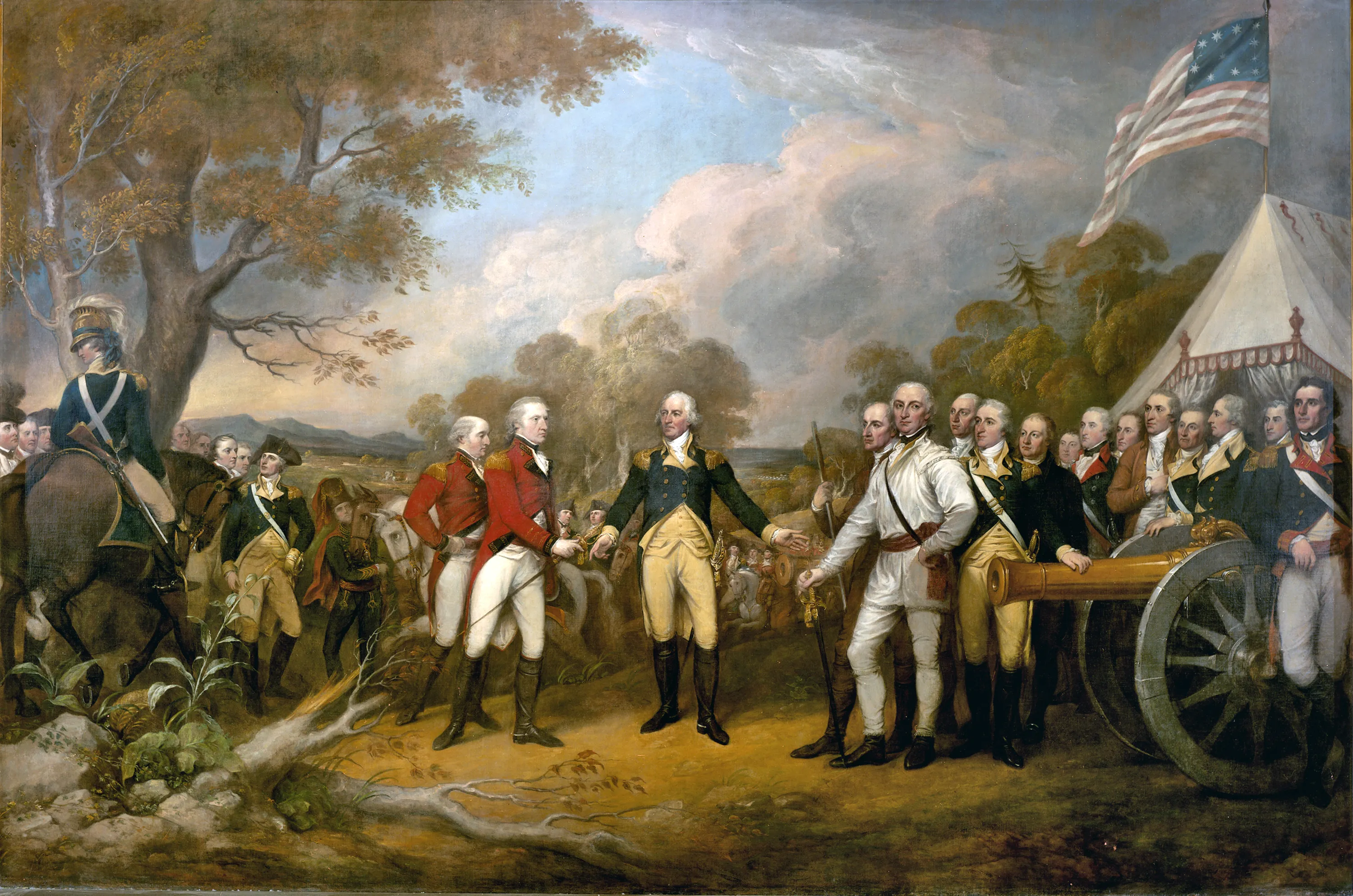
Start with 1781: Cornwallis, pinned against the York River for three weeks and his redoubts overrun, wrote to Washington asking for a day's truce and terms. Washington gave him two hours to put it in writing. Worth a longer look: 1989, when the ground split open during Game 3 of the World Series, the Nimitz Freeway pancaked, and a nation watching baseball found itself watching a disaster instead. Saratoga's surrender belongs in the same breath as Yorktown, bookends on the war it decided.
— The Patriot Compass desk
1781Featured · This day in history
Cornwallis asks Washington for terms; his guns have been silenced for days
By mid-October 1781, Cornwallis's army at Yorktown had been pinned against the York River for nearly three weeks, pounded by French and American guns, with de Grasse's fleet blocking any rescue by sea in the Chesapeake. On October 17, with his last major redoubts overrun two days earlier and his camp disintegrating under bombardment, Cornwallis sent a letter to Washington asking for a twenty-four-hour truce and terms of capitulation. Washington answered the same day, allowing two hours for the British to submit their proposal in writing. The surrender was signed two days later.
Yorktown pushed London to open peace talks, which eventually produced the Treaty of Paris recognizing American independence. Hamilton, who had led the bayonet charge on Redoubt No. 10 three days earlier, used that fame to help build the Constitution and the Treasury. A field officer's October note became the hinge of a founding resume.
Did you know
QWhy did Alexander Hamilton end up leading the charge on Redoubt No. 10 instead of Lafayette's chosen officer?
Lafayette initially tapped his own aide, Jean-Joseph Sourbader de Gimat, to lead the American assault on Redoubt No. 10. Hamilton objected, arguing that as the senior officer present he held the right to command the attack. Washington sided with Hamilton, handing him the mission. Hamilton then sent Lieutenant Colonel John Laurens around to the redoubt's rear to cut off any British retreat. The assault went in with unloaded muskets, bayonets only, to preserve surprise in the dark. Hamilton's men broke through in minutes, capturing the redoubt's commander, Major Campbell, along with most of the garrison, at a cost of nine dead and twenty-five wounded. A dispute over seniority put him on the path to the battlefield fame he later leveraged in politics.
QWhat happened to the slaughtered horses during the siege, and why did the British kill them?
On October 1, allied troops learned from British deserters that Cornwallis's men had slaughtered hundreds of horses inside Yorktown and dumped the carcasses on the beach. The killings were a grim supply decision: with the town cut off by land and sea, every animal still eating army rations was a mouth the garrison could no longer afford to feed as food stores dwindled under the tightening blockade. The dead horses piling up on the shoreline were one more sign to the besiegers that Cornwallis's position was unraveling. Deserters crossing into allied lines kept Washington's command informed of conditions inside the British perimeter throughout the siege.
QWhat happened when British cavalry under Banastre Tarleton collided with Lauzun's Legion during a foraging raid?
On October 3, Tarleton led a British foraging party out of Gloucester Point toward the countryside, only to run into Lauzun's Legion and Virginia militia under the Marquis de Choisy. The clash sent the British cavalry retreating back behind their own defensive lines, having lost fifty men in the skirmish. The raid itself had been cover: British cannon had opened a heavy barrage the night before specifically to mask the movement of cavalry across to Gloucester for the foraging mission. It was one of the last offensive actions Cornwallis's forces managed before the siege artillery began its sustained bombardment on October 9, and it cost him cavalry he could not replace.
The Daily Record · free by email
Tomorrow's edition in your inbox — one story, one quote, the flag.
1933science
Einstein steps off the boat in America, a scientist with no country to go home to
By the autumn of 1933, Albert Einstein had no passport from the country that once claimed him as its most famous scientist. He had renounced his German citizenship in March, after Hitler's rise made clear he would never safely return, and spent the months since drifting between Belgium and England. On October 17, 1933, Einstein arrived in the United States to take up a position at the newly founded Institute for Advanced Study in Princeton, New Jersey. He did not return to Germany.
Princeton's Institute for Advanced Study, barely off the ground when Abraham Flexner recruited Einstein, became living proof that America could be the destination for Europe's displaced scientific talent. Einstein's arrival helped set a pattern: within a decade, émigré physicists were pulled into the Manhattan Project, and the center of theoretical physics shifted from Berlin and Göttingen to American campuses for the rest of the century.
Did you know
QWhy did Einstein give up his German citizenship once before, decades before Hitler ever took power?
Einstein first renounced his German citizenship in 1895, at age sixteen, to avoid compulsory military service, and moved to Switzerland. He acquired Swiss citizenship in 1901 and kept it for the rest of his life, even after 1933. In 1914 he reversed course and returned to Berlin, taking up Prussian and German citizenship again to work at the Prussian Academy of Sciences. That second German citizenship is the one he surrendered in 1933. So when he stepped off the boat in Princeton, he was not technically stateless in the strictest sense, his Swiss passport still existed, but it was no longer the one tied to his scientific career or his German-speaking academic world.
QWhat specific warning did Einstein help send to Roosevelt years after he settled in Princeton?
Einstein never worked on the bomb itself, but the chain of events that produced it started with a signature he added in 1939. He put his name to a letter warning Franklin D. Roosevelt that Germany might be pursuing nuclear weapons and urging American research into fission, a warning that helped trigger the Manhattan Project.
QHow long did it take Einstein to become a naturalized American citizen after he landed in Princeton?
Einstein did not become a US citizen the moment he arrived. He landed in October 1933 but waited seven years, finally gaining American citizenship in 1940. That was the same era in which he was pressing Roosevelt about the danger of a German atomic program. For most of the 1930s he lived and worked in Princeton as a man without an American passport, his legal status unsettled even as the Institute for Advanced Study built its reputation around him. Once naturalized, he kept his Swiss citizenship alongside his new American one for the rest of his life, holding passports from two countries and none from the one where he was born.
1989tragedy
A 6.9 quake hits the Bay Area as the World Series is about to start on live national TV
At 5:04 p.m. on October 17, 1989, millions of Americans were tuned in to ABC for Game 3 of the World Series between the San Francisco Giants and Oakland Athletics when the broadcast cut to static. A magnitude 6.9 earthquake centered in the Santa Cruz Mountains had just ruptured the ground across the Bay Area. A section of Oakland's double-deck Nimitz Freeway pancaked. Part of the Bay Bridge fell. Buildings crumbled from Santa Cruz to San Francisco's Marina District. Sixty-three people died and property damage reached an estimated $6 billion.
The Forest of Nisene Marks State Park, Santa Cruz County, CaliforniaStory page →
Because the quake hit live during a World Series broadcast watched coast to coast, it became one of the first disasters Americans experienced in real time on national television, and it set a new expectation for live disaster coverage. Congress and President Bush responded fast, with a $1.1 billion relief package signed within nine days. Separately, the quake's confusing magnitude reports pushed the U.S. Geological Survey toward the moment-magnitude standard still used in American seismology today.
Did you know
QWhy did KTVU's news anchors end up reporting from a parking lot?
The Oakland-based Fox affiliate went off the air when the quake hit, like most Bay Area stations, but came back roughly an hour and 40 minutes later with anchors Dennis Richmond and Elaine Corral broadcasting from the station's own parking lot rather than a damaged studio. KGO-TV was dark for about 15 minutes, KRON-TV for half an hour, and KGO-AM radio for 40 minutes. KCBS-AM stayed on air by switching to backup power, surviving even a generator failure, and later won a Peabody Award for its coverage, as did KGO-TV.
QWhat went wrong with the Bay Area's official emergency alert system?
KNBR-AM was the designated Emergency Broadcast System station for the region in 1989, meaning it was supposed to issue official instructions to the public during a catastrophe. Its engineering department suffered major technical failures after the quake and never activated the system. San Francisco Mayor Art Agnos ended up giving public updates over KNBR-AM anyway.
QWhat is a sand volcano, and where did they appear after the quake?
Liquefaction near Watsonville was severe enough to push saturated sand up through cracks in the ground, forming small cone-shaped mounds called sand volcanoes in a strawberry field near Pajaro. The same ground failure cracked the front of Ford's department store in Watsonville, destroyed a causeway at Moss Landing, and knocked homes off their foundations if they hadn't been bolted down. Twin bridges over Struve Slough near Watsonville also failed structurally.
$17.76 your first year · then $39.99/yr · cancel anytime
Quote of the day
“Nobody will ever deprive the American people of the right to vote except the American people themselves.”
Franklin D. Roosevelt
“The fate of the country does not depend on how you vote at the polls — the worst man is as strong as the best at that game; it does not depend on what kind of paper you drop into the ballot-box once a year, but on what kind of man you drop from your chamber into the street every morning.”
Henry David Thoreau
“Let me now take a more comprehensive view, and warn you in the most solemn manner against the baneful effects of the spirit of party, generally.”