Reading 3 of 6 free1776 Club · all 6 storiesFriday, October 16
From the desk
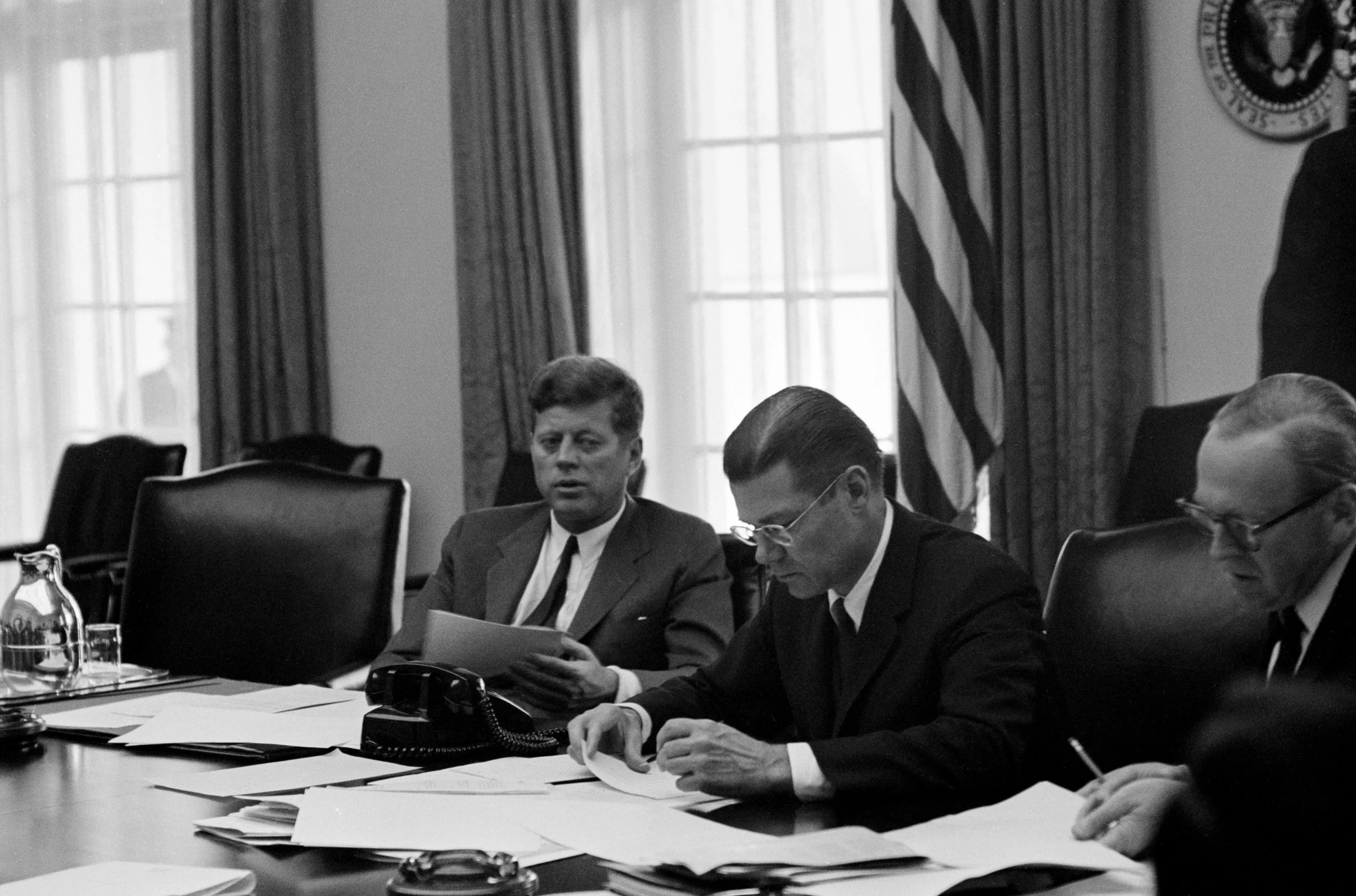
Start with 1859: John Brown and eighteen men walked into Harpers Ferry after dark and seized the federal armory, meaning to arm enslaved people across the South. No uprising came. By morning militia had him surrounded, and the country had a preview of 1861. Worth a longer look: 1962, when Kennedy opened a folder of U-2 photographs and found Soviet missiles under construction ninety miles from Florida, the quiet start of thirteen days nobody outside a small room knew about yet. Lighter fare: a ten-foot stone "giant" turned up in a New York farmer's well, fifty cents a look.
— The Patriot Compass desk
1859Featured · This day in history
John Brown and eighteen men seize the federal armory at Harpers Ferry
By the fall of 1859, by 1859 opponents of slavery were no longer only arguing about it in Congress. On the night of October 16, John Brown led roughly eighteen followers into Harpers Ferry, Virginia, and seized the U.S. Armory and Arsenal along with the nearby rifle works, taking local residents hostage as they went. Brown meant to arm enslaved people from the captured federal weapons and set off a wider insurrection across the South. No general uprising began. Within hours, local militia had the armory surrounded.
Harpers Ferry turned slavery from a political argument into an armed one. Brown's raid convinced many Southerners that the North meant to end slavery by force, and Southern leaders cited the raid in the secession debates that followed within fifteen months. It also gave the Union its first wartime song, as "John Brown's Body" became marching music for Union soldiers, most of whom had never heard of him before the war.
Did you know
QWhich of John Brown's sons actually fought at Harpers Ferry, and what happened to them?
Five of Brown's sons were tied to the raid in some capacity, but only Owen, Watson, and Oliver actually crossed into Harpers Ferry with him, alongside son-in-law Henry Thompson. Watson and Oliver were both killed in the fighting. Owen escaped the siege and fled west, evading capture for the rest of his life. Jason and Salmon Brown had been involved in earlier anti-slavery violence in Kansas but were not part of the raiding party itself. Brown lost two sons inside the engine house walls, one of ten raiders killed defending a plan that never sparked the revolt Brown had promised them.
QWhose daughter did Brown's men hold hostage inside the armory?
Brown's raiders seized the daughter of the armory's superintendent as one of several hostages taken during the initial strike, underscoring how personal and local the raid's first hours were before federal troops ever arrived. The hostages were held inside the engine house alongside Brown's own men as the siege tightened around them. Brown apparently believed hostages would give him leverage to negotiate or stall for the uprising he expected to materialize. No ransom or exchange ever came into play. When the Marines stormed the building, the hostages were freed unharmed, though papers barely mentioned it once Brown's conviction and hanging took over the headlines.
QWhat did Frederick Douglass say after spending a night with Brown before the raid?
Douglass met with Brown in Springfield, Massachusetts, years before Harpers Ferry, and the encounter left him shaken rather than inspired. He later wrote that from that night spent with Brown, he felt "all the same less hopeful" of slavery's peaceful abolition. Douglass had actually been invited to join the raid itself and refused, judging it suicidal, but the earlier conversation had already convinced him that moral argument alone would not end slavery. His private pessimism, recorded well before the raid made headlines, shows that Brown had already shifted Douglass's thinking toward violence long before a single shot was fired at the armory.
The Daily Record · free by email
Tomorrow's edition in your inbox — one story, one quote, the flag.
1923culture
Walt and Roy Disney start a cartoon studio out of a Hollywood real-estate office
On October 16, 1923, Walt Disney and his brother Roy founded the Disney Brothers Cartoon Studio in Hollywood. Roy was recovering from tuberculosis at the Sawtelle Veterans Home when Walt showed up late at night to tell him a New York distributor named Margaret Winkler had agreed to buy a series of short films called the Alice Comedies. Roy agreed to join him and checked out of the hospital the next morning. The two set up shop in the back of a real-estate office on Kingswell Avenue, Roy ran the money and Walt ran the ideas.
A hospital bedside handshake between two brothers became the founding act of the twentieth century's largest entertainment company, built from nothing but a distribution contract and a borrowed back room in Hollywood. The arrangement they settled that night, Roy on the ledgers and Walt on the stories, set the pattern for American studio filmmaking: creative vision backed by disciplined business management.
Did you know
QWhat was Roy Disney's job before the tuberculosis diagnosis sidelined him?
Roy had worked in banking, which is precisely why Walt wanted him in on the deal rather than just a loyal relative to split the work with. Walt needed someone who understood contracts, payroll, and the kind of financial discipline that a twenty-one-year-old artist with one distribution agreement did not yet have. That background shaped the entire structure of the partnership: Roy handled money and management for the rest of his career, while Walt never had to learn it. The arrangement outlasted both men and shaped how the studio split creative and business leadership for generations.
QHow many films did Margaret Winkler's original contract actually commit the Disneys to deliver?
Winkler's deal called for six Alice Comedies outright, with an option to pick up two further series of six episodes each if the first batch sold. That meant the entire studio, at its founding, existed to fulfill an order for exactly six short films, with no guarantee of anything beyond that. Winkler herself had built her reputation distributing Felix the Cat cartoons in New York, and the Alice format, a live-action girl interacting with animated characters, was unproven when she signed off on it. The option clause is what gave Roy and Walt room to grow past that first six-picture commitment.
QWhat happened to Roy's health after he walked out of the veterans home that morning?
Roy's own account of the decision notes that he never suffered another relapse of tuberculosis after leaving the Sawtelle Veterans Home to join Walt's venture. He had been convalescing there for an extended stretch before that late-night visit, and by every measure the disease should have kept him under care far longer. Instead, he walked out the next morning and spent the following decades running one of the largest entertainment companies ever built, logging the long hours that a recovering tuberculosis patient would have been warned against. The relapse never came.
1869culture
Well diggers near Cardiff strike a ten-foot stone giant
A Methodist revival argument over giants in Genesis had been simmering for nearly a year before the dig. On October 16, 1869, laborers Gideon Emmons and Henry Nichols, digging a well for farmer William "Stub" Newell near Cardiff, New York, struck something hard just a few feet underground. What came up was a 10-foot, 3,000-pound stone figure, which Newell presented as a petrified ancient giant. Newell began charging fifty cents a head to see it the next day.
The Cardiff Giant became shorthand for American credulity and American showmanship in the same breath, while Yale scientist Othniel Marsh called it a fake and P. T. Barnum built his own copy to cash in anyway. David Hannum's line about suckers born every minute, misattributed to Barnum ever since, is still quoted today, long after most people have forgotten the hoax it came from.
Did you know
QWho actually carved the Cardiff Giant, and where did the work happen?
The carving was outsourced through a chain of hired specialists far from New York. George Hull shipped his quarried gypsum block to Edward Burkhardt, a German stonecutter in Chicago, who in turn brought in sculptors Henry Salle and Fred Mohrmann to do the actual carving. The block itself started out at Fort Dodge, Iowa, where quarrymen cut a slab measuring 10 feet 4.5 inches long before it ever reached Chicago. Hull never touched a chisel to the stone himself. He designed the operation and modeled the figure's proportions on his own body, but the physical sculpting was entirely the work of men he never mentioned publicly during the hoax's run. Their names surfaced only after Hull's confession unraveled the whole production.
QWhat happened to P. T. Barnum's rival copy of the giant after the hoax collapsed?
Barnum's unauthorized plaster copy did not vanish once the court declared both giants fakes on February 2, 1870. It survived the scandal and still exists today, on display at Marvin's Marvelous Mechanical Museum in Farmington Hills, Michigan, far from the Cooperstown museum that holds Hull's original. Additional replicas also outlived the controversy: one sits at The Fort Museum and Frontier Village in Fort Dodge, Iowa, near where the original gypsum was quarried, and another is housed at the Fenimore Farm & Country Village, just a few miles from the real giant in Cooperstown. The hoax produced at least four separate physical giants, now scattered across two states.
QHow much weight did the giant lose between being quarried and finished, and how long was it exactly?
The finished Cardiff Giant weighed 2,990 pounds, roughly ten pounds shy of the three thousand figure most retellings round it to. Its length ran 10 feet 4.5 inches, matching the exact dimensions of the raw gypsum slab Hull's quarrymen cut in Fort Dodge, Iowa, meaning the sculptors shaped a human figure out of nearly the entire block without trimming its overall length. The near-exact match between the slab's length and the finished figure's length is a detail of record, though no source says Hull planned it that way. Every inch and pound was accounted for, down to the ten pounds separating the giant from an even three thousand.
$17.76 your first year · then $39.99/yr · cancel anytime
Quote of the day
“Nobody will ever deprive the American people of the right to vote except the American people themselves.”
Franklin D. Roosevelt
“The fate of the country does not depend on how you vote at the polls — the worst man is as strong as the best at that game; it does not depend on what kind of paper you drop into the ballot-box once a year, but on what kind of man you drop from your chamber into the street every morning.”
Henry David Thoreau
“Let me now take a more comprehensive view, and warn you in the most solemn manner against the baneful effects of the spirit of party, generally.”