Reading 3 of 7 free1776 Club · all 7 storiesWednesday, October 7
From the desk
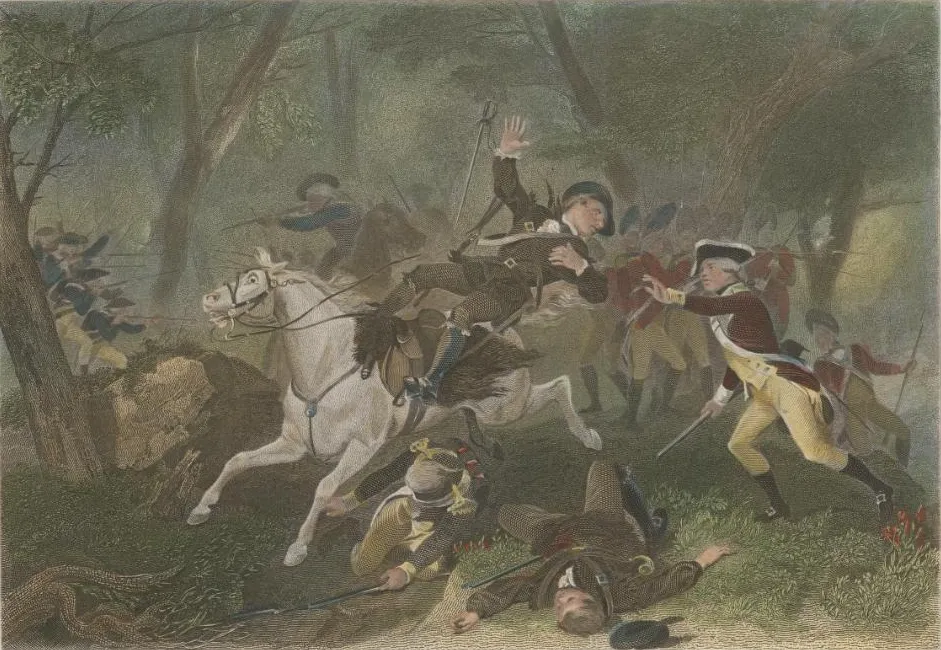
Start with 2001: four weeks after September 11, the Taliban still hadn't given up bin Laden, and that evening U.S. and British warplanes hit Taliban targets while special forces linked up with the Northern Alliance on the ground. Bush called it a warning; it opened what became America's longest war. Worth a longer look: Kings Mountain in 1780, where backwoods militia cornered Patrick Ferguson's Loyalists on a wooded ridge and shot him seven times, forcing Cornwallis to abandon his push into North Carolina. Wake Island's story, quieter and darker, belongs in the same sitting.
— The Patriot Compass desk
2001Featured · This day in history
American bombs fall on Afghanistan; Bush says "time is running out"
Four weeks after September 11, the Taliban still refused to hand over Osama bin Laden. On October 7, 2001, U.S. and British warplanes struck Taliban air defenses, training camps, and troop positions across Afghanistan, while American special operations forces began linking up on the ground with the Northern Alliance. President Bush announced the strikes that evening, warning that "full warning has been given, and time is running out." It was the opening day of what became the longest war in American history.
October 7 began a twenty-year commitment to a war without fronts or surrender ceremonies. It set the template of special operators embedded with local militias and airpower in place of mass invasion, a template that guided American responses to terrorism for a generation. It also opened a conflict whose end, in the Taliban's 2021 return to Kabul, Americans are still arguing over.
Did you know
QHow many Pakistani volunteers crossed the border to fight for the Taliban?
About 10,000 Pakistani volunteers streamed across the border by mid-October 2001 to reinforce Taliban ranks. They were mostly madrassa students from the frontier region, some as young as 14, joining a fight that had little to do with their own country's government, which was publicly siding with Washington even as fighters slipped over to the other side. The influx showed how porous the Afghan-Pakistan border already was before the war even began, a problem that haunted coalition forces for the next two decades as Taliban fighters used the same crossings to retreat and resupply. Pakistan's own intelligence services had long-standing ties to the Taliban, reflecting divided loyalties that would mark the war for years afterward.
QWhat combat aircraft did the Taliban have left to meet American and British bombers?
The Taliban fielded roughly 40 combat aircraft against the opening American and British air assault, a scattered fleet of aging Soviet-era jets that stood almost no chance against modern warplanes. Ground forces fared little better for mobility, leaning on civilian pickup trucks rather than armored vehicles for transport across the country. The mismatch meant the first strikes targeted air defenses specifically to clear the sky fast, since the Taliban's air power posed more of a theoretical obstacle than a real one. Within days, American and British aircraft operated over Afghanistan with little opposition from the air. The war was then decided almost entirely by ground fighting between the Taliban and Northern Alliance.
QWho was leading the Northern Alliance when American bombs started falling, and what happened to its previous commander?
The Northern Alliance went into the war having lost its longtime commander, Ahmad Shah Massoud, who was assassinated on September 9, 2001, just two days before the September 11 attacks in the United States, making it only two days, not a longer gap. His killers posed as journalists and detonated explosives hidden in a camera during a staged interview, a plot widely attributed to al-Qaeda operatives. Massoud had fought the Taliban since 1996 and was the alliance's most recognized leader. His death left the coalition of anti-Taliban fighters without its central figure as American special forces arrived.
The Daily Record · free by email
Tomorrow's edition in your inbox — one story, one quote, the flag.
1943tragedy
Ninety-eight American prisoners are shot on a Wake Island beach
Wake Island had been a U.S. territory since 1899, though significant development only began in the 1930s, when Pan American Airways made the coral speck a refueling stop for its trans-Pacific flying boats. Japan seized it in December 1941, days after Pearl Harbor, and kept roughly ninety-eight American civilian workers behind to labor under occupation. On October 5, 1943, Japanese forces marched the group to a beach and shot them. The killings went undiscovered by the outside world until the war's end.
Wake Island's dead were not soldiers but Pan American and contractor employees, caught by an invasion while building American infrastructure. Their execution was later prosecuted as a war crime after Japan's surrender. The island itself remains a U.S. territory, administered by the Department of the Interior and managed by the United States Air Force, a small permanent marker of that occupation.
Did you know
QWhy did Pan American Airways need a refueling stop in the middle of nowhere like Wake Island?
Flying boats of the 1930s could not cross the Pacific in one hop, so Pan Am built a chain of island stations to bridge the distance between Honolulu and Guam. Wake Island, a coral atoll with no native fresh water or population, became one link in that chain, fitted with a hotel for passengers and fuel depots for the aircraft. The same remoteness that made it useful for refueling later made it strategically attractive to Japan, since whoever held Wake controlled a waypoint between major Pacific bases. The civilian workforce building and running that refueling station is what put ordinary contractors directly in the path of invasion in December 1941. Within days, the refueling stop became a combat zone.
QWhat species vanished from Wake Island as a direct result of the war?
The Wake Island rail, a small flightless bird found nowhere else on Earth, went extinct during the Japanese occupation. Cut off from resupply and facing starvation, the occupying garrison hunted the bird to extinction for food sometime before the war's end in 1945. The rail had survived on the isolated atoll precisely because it had no natural predators and no need to fly, a trait that made it easy prey once hungry soldiers turned to it as a food source. Its disappearance is recorded in the island's wartime history, though it drew far less attention than the human deaths. No other population of the bird existed anywhere else to repopulate the species.
QHow isolated was Wake Island compared to its nearest neighbor?
The nearest inhabited land to Wake was Utirik Atoll in the Marshall Islands, roughly six hundred miles away, a distance that left the island's workers with no realistic hope of escape or rescue during the occupation. That isolation made Wake easy for Japan to seal off, since no neighboring population could report on conditions there. Six hundred miles of open Pacific separated the captives from any other human settlement, a gap that made the atoll one of the more remote outposts held by either side in the war. Japanese control of the island, not just its distance from other settlements, kept news of the killings from surfacing until 1945.
1940military
A Navy memo floats a plan: push Japan into firing the first shot
Fourteen months into the war in Europe, with Germany controlling territory from Poland to the French coast, the United States remained officially neutral. On October 7, 1940, Lieutenant Commander Arthur H. McCollum, head of the Far East desk at the Office of Naval Intelligence, sent Navy Captains Dudley Knox and Walter Stratton Anderson an eight-part memo on pressuring Japan, from aiding China to embargoing oil. McCollum wrote that if Japan could be led to "commit an overt act of war, so much the better." Knox worried the memo would pull resources away from the Atlantic, where Britain's survival was at stake.
Office of Naval Intelligence, Washington, D.C.Story page →
The memo's own recommendations, especially the oil embargo, became actual U.S. policy within a year, and historians like Stinnett and Crane still disagree over whether that policy was meant to deter Japan or provoke it. That argument is why Pearl Harbor still raises an uncomfortable question: did Washington see it coming, and did it want to?
$17.76 your first year · then $39.99/yr · cancel anytime
Quote of the day
“Quality is more important than quantity. One home run is much better than two doubles.”
Steve Jobs
“Let us ever remember that our interest is in concord, not in conflict; and that our real eminence rests in the victories of peace, not those of war.”
William McKinley
“The jaws of power are always open to devour, and her arm is always stretched out, if possible, to destroy the freedom of thinking, speaking, and writing.”