Reading 3 of 6 free1776 Club · all 6 storiesSunday, September 27NarratedView on the map →
From the desk
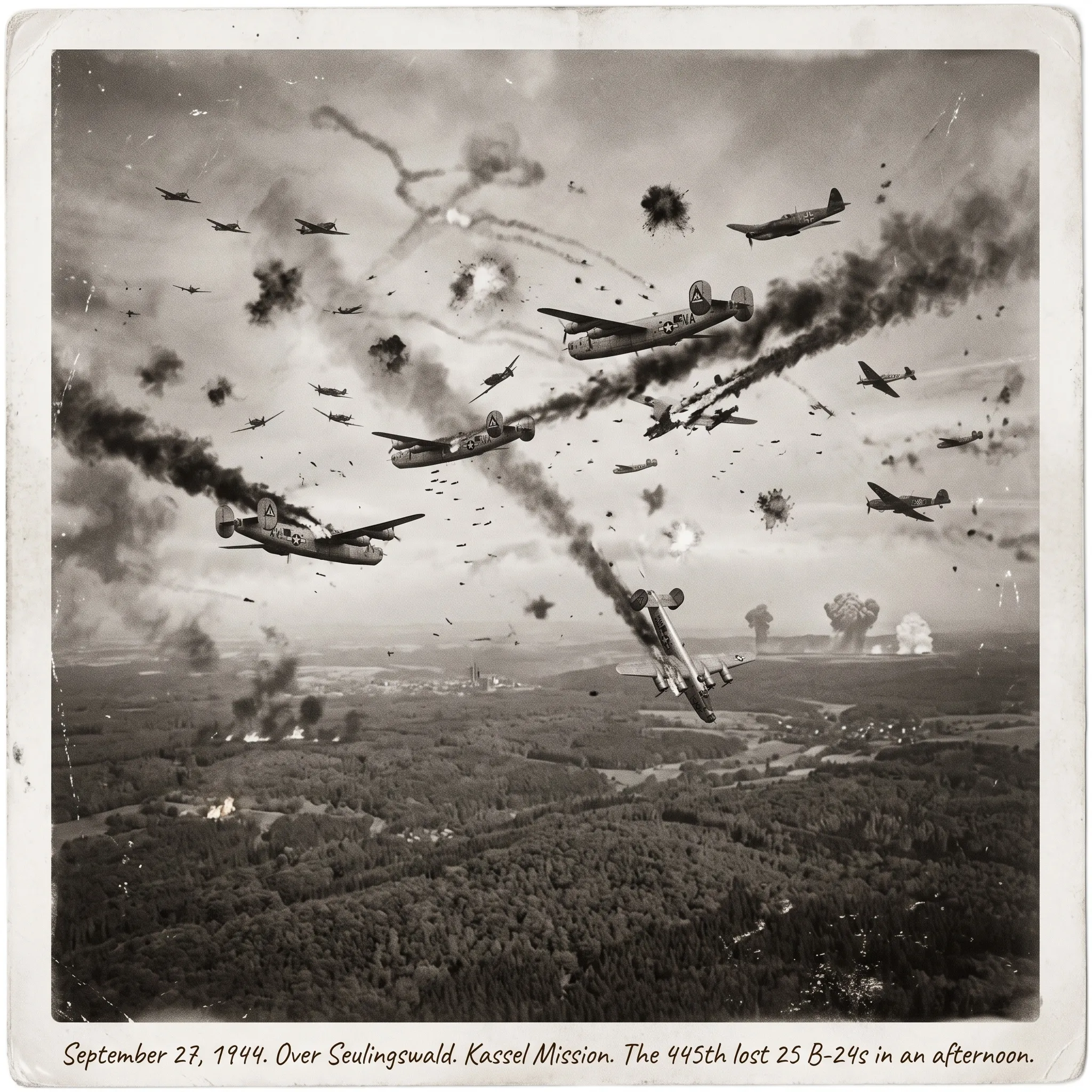
Start with 1940: Germany, Italy, and Japan signing the Tripartite Pact in Berlin, three months after France fell and with Britain standing alone. It wasn't an alliance built on trust; it was Germany and Italy carving up Europe while Japan claimed Asia and the Pacific for itself. Worth a longer look: the Kassel Mission of 1944, when a navigation error sent 35 B-24s toward the wrong target and 150 German fighters caught them without cover, costing the 445th Bomb Group 25 aircraft in minutes. Also worth a glance: Ford's first production Model T, hand-built in Detroit in 1908.
— The Patriot Compass desk
The American Record · Daily briefing
Today's edition, narrated
free for everyone · listen on Apple, Spotify & more
1940Featured · This day in history
Berlin ceremony formalizes Germany, Italy, and Japan into the Axis alliance
France had fallen three months earlier, and Britain stood alone against Germany in the west. On September 27, 1940, representatives of Nazi Germany, Fascist Italy, and Imperial Japan gathered in Berlin and signed the Tripartite Pact, binding each nation to come to the others' aid if any were attacked by a power not already at war with them. The agreement gave formal shape to what the world would soon call the Axis. It was less a friendship than a division of spoils: Germany and Italy took Europe for their sphere. Japan took Asia and the Pacific.
The United States was not a party to the pact, but its architects wrote it with Washington in mind: the mutual-defense clause targeted "a power not already at war" with any signatory, meaning the still-neutral United States. The pact hardened American opinion toward Japan and accelerated the embargoes that preceded Pearl Harbor about fourteen months later.
The Daily Record · free by email
Tomorrow's edition in your inbox — one story, one quote, the flag.
1908innovation
First production Model T leaves the Piquette Avenue Plant in Detroit
Henry Ford had spent two decades and several failed companies chasing one idea: a car ordinary families could afford. On September 27, 1908, the first production Model T came together at the Ford Piquette Avenue Plant in Detroit, built by hand at fixed stations from parts carried over by workers. It carried a 177-cubic-inch four-cylinder engine making 20 horsepower, a top speed of 42 miles per hour, and a body framed in vanadium steel. Full production started four days later, on October 1.
The Model T rearranged American geography and daily life. Rural families who had never left their county could now reach town in an afternoon, and by the time production ended in 1927 more than 15 million had sold, remaking how Americans worked and shopped. The 1999 Car of the Century judges called it the most influential automobile of the 1900s.
Did you know
QWhat single-day production record did the Piquette Avenue Plant set before the Model T even existed?
On June 4, 1908, workers at the Piquette Avenue Plant completed 101 cars in a single day, an auto industry record at the time. That output came three months before the first production Model T emerged from the same building, meaning the plant had already proven it could move vehicles through fixed assembly stations at a pace no competitor matched. The record involved earlier Ford models being built at the plant, not the Model T itself. The record came three months before the Model T itself went into production. Fourteen thousand more Model Ts would later come off that same floor.
QWhat honor did the Piquette Avenue Plant receive nearly a century after the Model T left it?
The building became a museum in 2001, then collected an unusual run of federal and state recognitions in quick succession: the National Register of Historic Places in 2002, Michigan State Historic Site status in 2003, and National Historic Landmark designation in 2006. That is four distinct honors in five years for a former textile-mill-style loft building in Detroit. The site had sat largely overlooked for decades after Ford moved production elsewhere, yet the recognitions arrived almost back to back once preservationists took interest. The building where Joseph Galamb and Childe Harold Wills once sketched the Model T's design now carries the same federal landmark status as sites tied to far older chapters of American history.
QWhy could Ford keep the Piquette plant free of labor unions for decades?
Ford Motor Company belonged to the Employers' Association of Detroit, a coalition of manufacturers that coordinated to keep unions out of the city's factories into the 1930s. Membership gave Ford cover to run Piquette as a non-union shop without facing the kind of isolated pressure a single company might draw on its own. The arrangement meant the workforce building the Model T had no collective bargaining voice. Detroit's broader manufacturing sector leaned on this association model for years, and Ford's participation in it kept Piquette's workforce without a union for decades, until the United Auto Workers organized the industry in the following decade.
1941military
Fourteen freighters hit the water at once; Roosevelt calls them Liberty ships
Britain was losing merchant ships to German U-boats faster than its yards could replace them, and the United States had agreed to help fill the gap with a stripped-down, mass-producible freighter. On September 27, 1941, SS Patrick Henry slid down the ways at Bethlehem-Fairfield Shipyard in Baltimore, the first of fourteen emergency vessels launched that day in a show called Liberty Fleet Day. Ilo Browne Wallace, wife of Vice President Henry Wallace, swung the christening bottle while President Roosevelt watched. Over the next several years, 2,710 of these ships would follow it into the water.
Liberty ships turned Baltimore, Portland, and a dozen other cities into round-the-clock steel factories. The program trained a generation of American welders and put women on the shipways years before Rosie the Riveter became a poster. The program's welded-hull shortcuts caused real failures, but it also proved American yards could out-produce any enemy could sink.
Did you know
QWho else besides the Vice President's wife stood at the christening bottle that day?
Two other women shared sponsor duties alongside Ilo Wallace: Mrs. Robert H. Jackson, wife of Supreme Court Associate Justice Robert Jackson, and Madame Bruggmann, wife of Switzerland's Minister to the United States, Karl Bruggmann. Madame Bruggmann had a personal stake beyond diplomacy: she was the vice president's own sister, making the ceremony something of a family affair dressed up as wartime pageantry. Having a Supreme Court justice's wife and a foreign minister's wife flank the vice president's wife turned a single christening into a small tableau of executive, judicial, and diplomatic Washington standing together, not just a Maryland shipyard event.
QWhat other ships slid into the water beside Patrick Henry that same afternoon?
Six named vessels joined Patrick Henry among the fourteen launched on Liberty Fleet Day: SS John C. Fremont, SS Louise Lykes, SS Ocean Venture, SS Ocean Voice, SS Star of Oregon, and SS Steel Artisan. The spread of names (explorers, shipping-line namesakes, and abstract wartime nouns) hints at how naming conventions were still settling before the program locked into its pattern of honoring famous Americans. Patrick Henry got top billing and the presidential visit, but it was one hull among fourteen hitting the water at yards around the country that day. The coordinated multi-yard launch was itself the point, a single afternoon meant to prove the country's shipbuilding capacity all at once.
QHow did Patrick Henry's own hull number and eventual scrap value reflect its unglamorous end?
The ship carried Maritime Commission hull number 14 and, after surviving the entire war plus a 1946 grounding on a Florida reef, was sold to Bethlehem Steel for $76,191 on September 18, 1958. It sat idle in the National Defense Reserve Fleet at Mobile, Alabama for over a decade before that sale, then was formally withdrawn on October 22, 1958, and scrapped in Baltimore, the same city where Roosevelt had launched it seventeen years earlier. A ship built to symbolize wartime urgency ended its life as scrap metal, sold for a fraction of what it cost to build. It was scrapped in Baltimore, the same city where Roosevelt had launched it seventeen years earlier.