Reading 3 of 6 free1776 Club · all 6 storiesFriday, September 11
From the desk
Start with 2001. Clear skies, four flights, 102 minutes between the first strike and the fourth crash near Shanksville, where passengers who knew what was coming stormed a cockpit anyway. Everything else today is prelude by comparison, but read 1941 next: the Pentagon broke ground on the same date sixty years earlier, on a Hell's Bottom lot cleared for a five-sided building nobody knew would matter twice on this day. Hamilton's Senate confirmation, same afternoon he was nominated, is worth a glance too.
— The Patriot Compass desk
2001Featured · This day in history
Hijacked jets strike the World Trade Center and the Pentagon; a fourth crashes in a Pennsylvania field
Tuesday morning, clear skies over the East Coast. At 8:46, American Airlines Flight 11 struck the North Tower of the World Trade Center; seventeen minutes later, United Flight 175 hit the South Tower. At 9:37, American Flight 77 hit the Pentagon. At 10:03, United Flight 93 went down in a field near Shanksville, Pennsylvania, after passengers rushed the cockpit. Nineteen al-Qaeda hijackers killed 2,977 people and caused more than $10 billion in damage.
The attacks triggered the Global War on Terror and the U.S. invasion of Afghanistan, and prompted NATO to invoke Article 5 for the first time in its history. Nearly a quarter century later, the Costs of War Project estimates more than 4.5 million deaths tied to the conflicts that followed, and post-Cold War American foreign policy shifted decisively in its wake.
Did you know
QWhy couldn't the FBI be told that two future hijackers were already inside the United States?
CIA agent Tom Wilshire emailed superiors at the CIA's Counterterrorism Center on July 13, 2001, requesting permission to tell the FBI that Nawaf al-Hazmi was in the country and Khalid al-Mihdhar held a U.S. visa. The CIA never responded. Weeks earlier, an FBI liaison had asked to share word of a January 2000 al-Qaeda meeting in Malaysia with the Bureau and was told flatly, "This is not a matter for the FBI." FBI analyst Margarette Gillespie was even shown surveillance photos of the two men from that meeting but was never told why they mattered. Both men helped hijack Flight 77 two months later.
QWhat real-world plane crash gave bin Laden the idea for 9/11?
In handwritten notes titled "The Birth of the Idea of September 11," seized during the 2011 raid on his compound, bin Laden credited the October 1999 crash of EgyptAir Flight 990. Co-pilot Gameel Al-Batouti deliberately downed the plane, killing more than 200 passengers. Bin Laden wrote that watching this unfold is "how the idea of 9/11 was conceived and developed in my head," and said only Mohammed Atef and Abu al-Khair knew of his thinking at the time. Khalid Sheikh Mohammed, later identified as the operation's architect, is never mentioned in bin Laden's own account of the idea's origin.
QWhich Los Angeles skyscraper was originally on al-Qaeda's target list but got dropped?
Khalid Sheikh Mohammed's original 1996 pitch to bin Laden included the Library Tower in Los Angeles, now known as the U.S. Bank Tower, among the buildings hijacked planes could crash into. Bin Laden rejected that early version of the plan for being too elaborate. Two of the hijackers meant to serve as pilots, Nawaf al-Hazmi and Khalid al-Mihdhar, arrived in San Diego in January 2000 and began flying lessons but performed so poorly that they were reassigned as secondary "muscle" hijackers instead, a demotion that changed who ended up at the controls on the day of the attacks.
The Daily Record · free by email
Tomorrow's edition in your inbox — one story, one quote, the flag.
1789government
Hamilton confirmed as Treasury Secretary within hours of his nomination
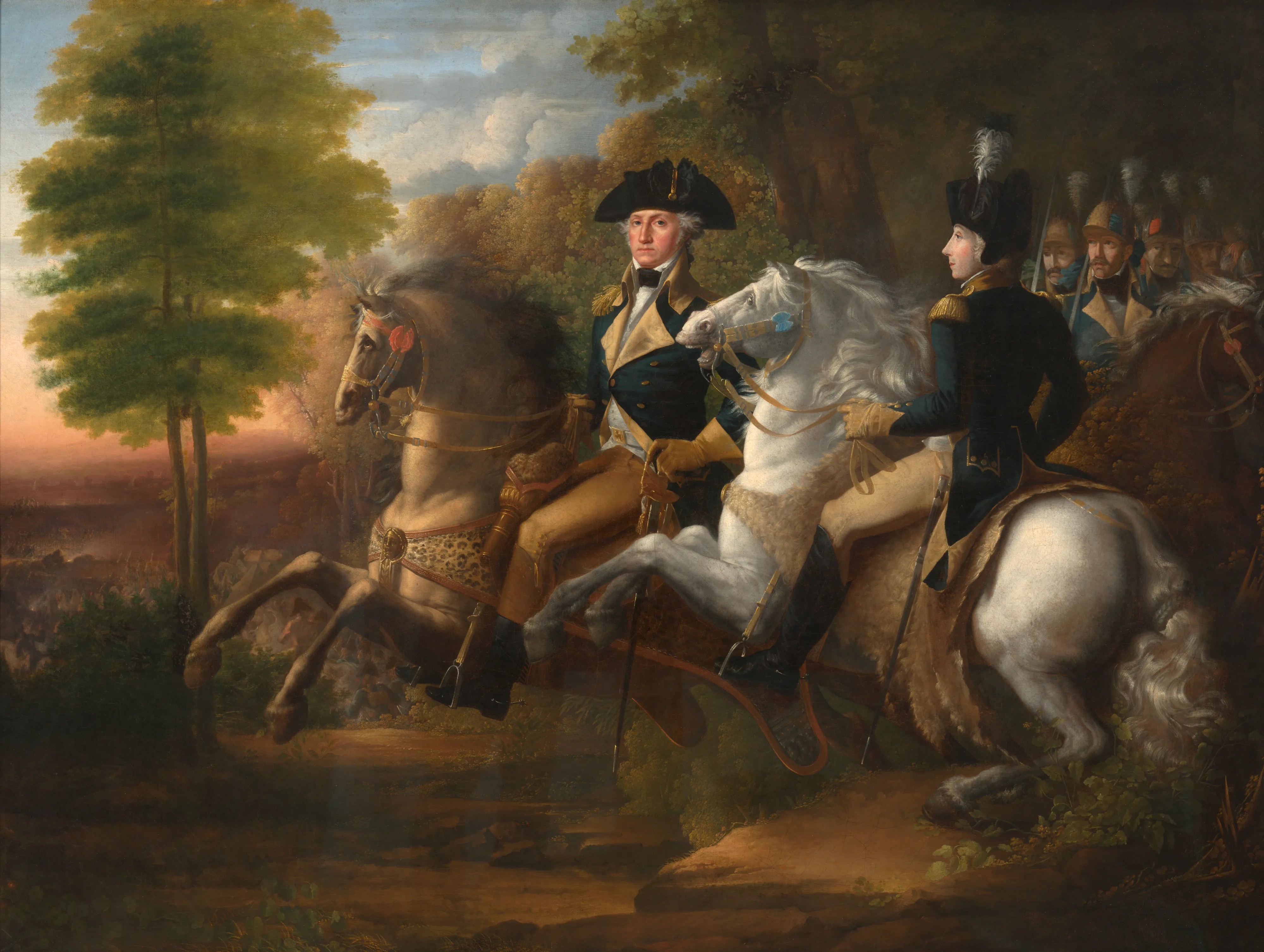
The new federal government was barely five months old and still had no one managing its money. On September 11, 1789, in New York City, President George Washington nominated Alexander Hamilton, his former wartime aide and a co-author of The Federalist Papers, to be the first Secretary of the Treasury. The Senate confirmed him that same day. Over the next six years, Hamilton built the financial system the young republic still runs on.
This is the moment the American financial state gets a name attached to it. Hamilton's same-day confirmation gave the Constitution's new Treasury Department its first officer, and within his six years in the post he built the debt assumption plan, the First Bank of the United States, and a national tax system, a framework whose disputes over federal power are still with us.
Did you know
QWhat childhood tragedy nearly derailed Hamilton before he ever reached America?
Hamilton was orphaned twice over on Caribbean islands before he turned fourteen. His mother, Rachel Lavien, died of yellow fever in 1768 after her estranged first husband's legal claim stripped the family of its household silver and belongings in probate court. The teenage Hamilton and his brother James were then taken in by cousin Peter Lytton, who died by suicide the following year, leaving his property to a mistress and cutting the brothers out entirely. Alexander, left with nothing, was taken in by merchant Thomas Stevens while James apprenticed to a carpenter. A friend bought back the family's auctioned books and returned them to Hamilton, one of the few possessions he carried out of that childhood.
QHow did a hurricane essay get a Caribbean clerk shipped off to college in America?
In 1772, Hamilton wrote his father a vivid, apocalyptic account of a hurricane that had leveled Christiansted, describing it as divine punishment for human vanity. His mentor, the Presbyterian minister Hugh Knox, submitted the letter to the Royal Danish-American Gazette, where it was published. Biographer Ron Chernow later called it astonishing that a self-taught clerk could write with such force. Local merchants were impressed enough to pool money for Hamilton's passage and education, and he sailed for Boston that October before heading to New York. That single essay paid for his passage off the island.
QWhat role did Hamilton play in the mob violence of the Revolution's early days?
On May 10, 1775, Hamilton talked down an angry crowd to save King's College president Myles Cooper, a Loyalist the mob wanted to punish. Hamilton supported the Patriot cause but personally disapproved of mob violence against Loyalists, and he stalled the crowd with a speech long enough for Cooper to escape. Around the same period he coordinated with Hercules Mulligan and the Sons of Liberty on an armed raid on British cannons at the Battery, done under fire from the warship HMS Asia, which got his militia company, renamed the Hearts of Oak, redesignated as an artillery unit. Two very different instincts, protection and combat, showed up in Hamilton within months of each other.
1941military
Shovels hit dirt at Hoover Field; the War Department breaks ground on a five-sided headquarters
The War Department's staff had outgrown the Munitions Building years earlier, scattered across seventeen locations around Washington. On September 11, 1941, construction began on a new headquarters across the Potomac in Arlington County, Virginia, on the site of the old Washington-Hoover Airport. Contracts totaling $31,100,000 were finalized the same day. Architect George Bergstrom's design kept the five-sided shape President Roosevelt preferred, even after the site itself was relocated from its original location at Arlington Farms. Workers cleared the Hell's Bottom neighborhood to make room for it.
Built under wartime steel rationing with concrete ramps instead of elevators, the Pentagon's name became shorthand for the Defense Department itself. The Pentagon was also the only building in Virginia where segregation laws went unenforced, a change forced by a cafeteria protest and Roosevelt's direct order to remove segregation signage, not by wartime necessity.
Did you know
QWhy did a Black draftsman's cafeteria protest in 1942 force Somervell's hand at the Pentagon?
In May 1942, ordnance draftsman Jimmy Harold refused to eat in the Pentagon's Blacks-only cafeteria and kept eating alongside white workers for several days until a white security guard beat him. Judge William Hastie, the Black civilian aide to Secretary Stimson, got an investigation authorized, and General Brehon Somervell ordered the "discontinuance of any enforced segregation of negro employees in the cafeterias." When Roosevelt later toured the building before its dedication, he ordered the Whites Only signs torn down entirely. When Virginia's governor objected, the administration simply replied that the Pentagon sat on federal jurisdiction. Those segregation laws stood elsewhere in Virginia until 1965.
QHow much floor load did Somervell demand the Pentagon be built to withstand, and why?
Somervell required the structural design to bear up to 150 pounds per square foot, far beyond ordinary office use, in case the building needed to become a records storage facility once the war ended and the War Department shrank back down. Engineers used cast-in-place piles to handle the site's poor floodplain soil, since the Potomac floodplain elevation swung between 10 and 40 feet above sea level across the property, requiring two separate retaining walls just to level the grounds. The building was designed for a bureaucratic contraction that never actually came.
QWhat forced chief architect George Bergstrom off the Pentagon project before it was even finished?
Bergstrom resigned in April 1942, midway through construction, after being charged with unrelated improper conduct while serving as president of the American Institute of Architects. David J. Witmer took over as chief architect on April 11, just months after the Pearl Harbor attack had pushed Somervell to demand a million square feet of usable space by April 1943. Design work and construction were running simultaneously at that point, with crews sometimes building ahead of finished drawings and substituting materials never specified in the plans, so Bergstrom's exit landed at the project's most improvised stretch.